A field of artificial intelligence that focuses on developing systems that can learn and improve from experience without explicit programming.
Definition
Machine Learning is a branch of artificial intelligence that enables computers to learn patterns from data and improve their performance over time, without being explicitly programmed for specific tasks.
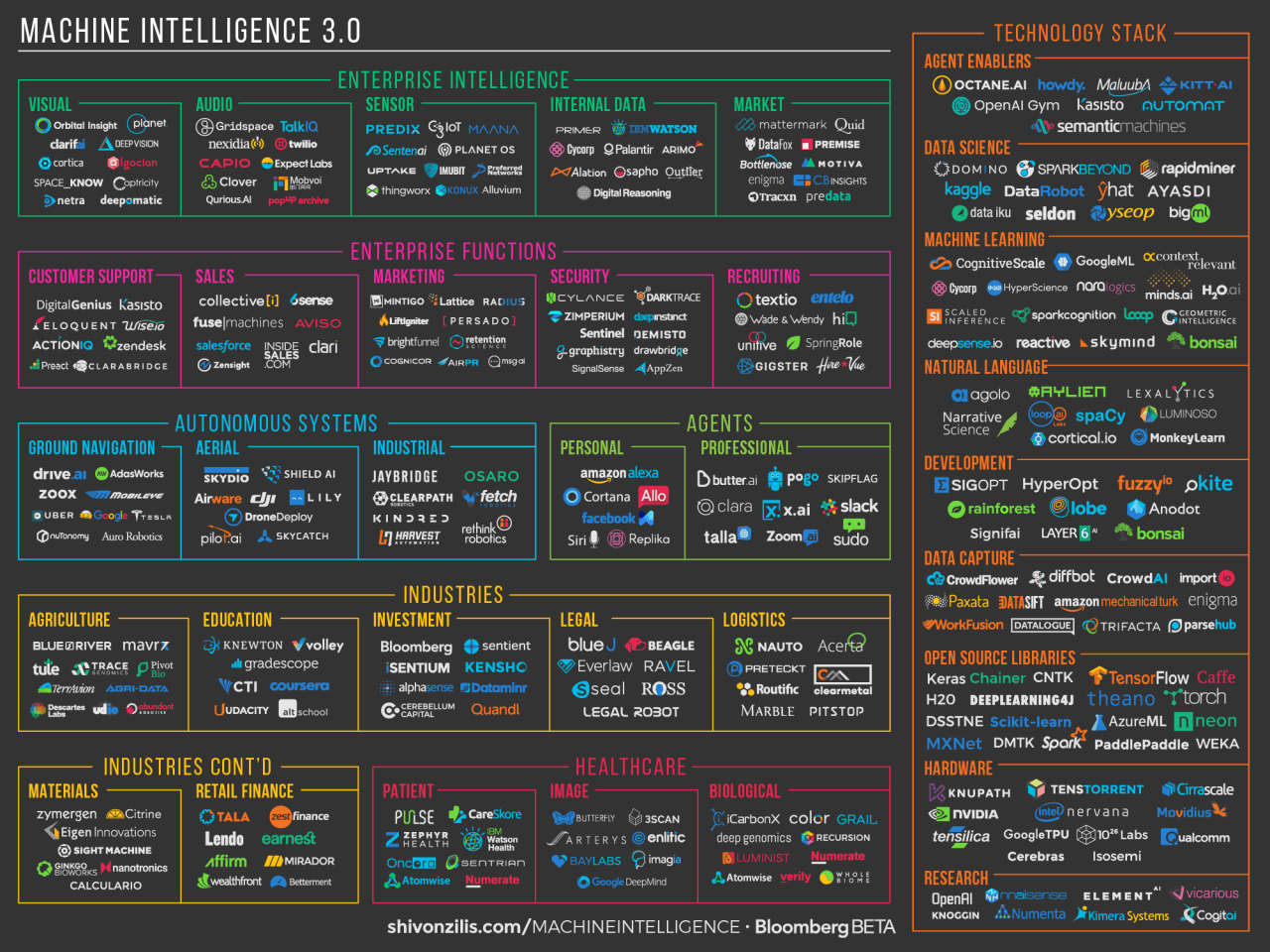
Machine Intelligence Industry
A growing ecosystem of companies is working on machine intelligence, developing tools, platforms, and applications that leverage machine learning capabilities to solve real-world problems.
Key Components
- Data Processing: Information analysis
- Pattern Recognition: Feature identification
- Model Training: Learning algorithms
- Performance Optimization: System improvement
- Prediction Systems: Future estimation
Types of Learning
- Supervised Learning: Guided training
- Unsupervised Learning: Pattern discovery
- Reinforcement Learning: Trial and error
- Deep Learning: Neural networks
- Transfer Learning: Knowledge application
Applications
- Natural Language Processing: Language understanding
- Computer Vision: Image recognition
- Robotics: Movement and interaction
- Recommendation Systems: Personalization
- Predictive Analytics: Future forecasting
Technical Implementation
- Neural Networks: Brain-inspired systems
- Algorithms: Learning methods
- Data Structures: Information organization
- Training Methods: Learning approaches
- Evaluation Metrics: Performance measurement
Impact Areas
- Technology: AI development
- Business: Process automation
- Science: Research advancement
- Society: Daily life integration
- Industry: Work transformation
Ethical Considerations
- Bias: Algorithmic fairness
- Privacy: Data protection
- Transparency: System understanding
- Accountability: Decision responsibility
- Access: Technology availability
Connections
- Foundation for Generative AI
- Related to AI as Tool
- Connected to AI as Child
- Example of AI Development
- Featured in AI Consciousness
- Influenced by AI Ethics
- Contrasts with AI as Threat