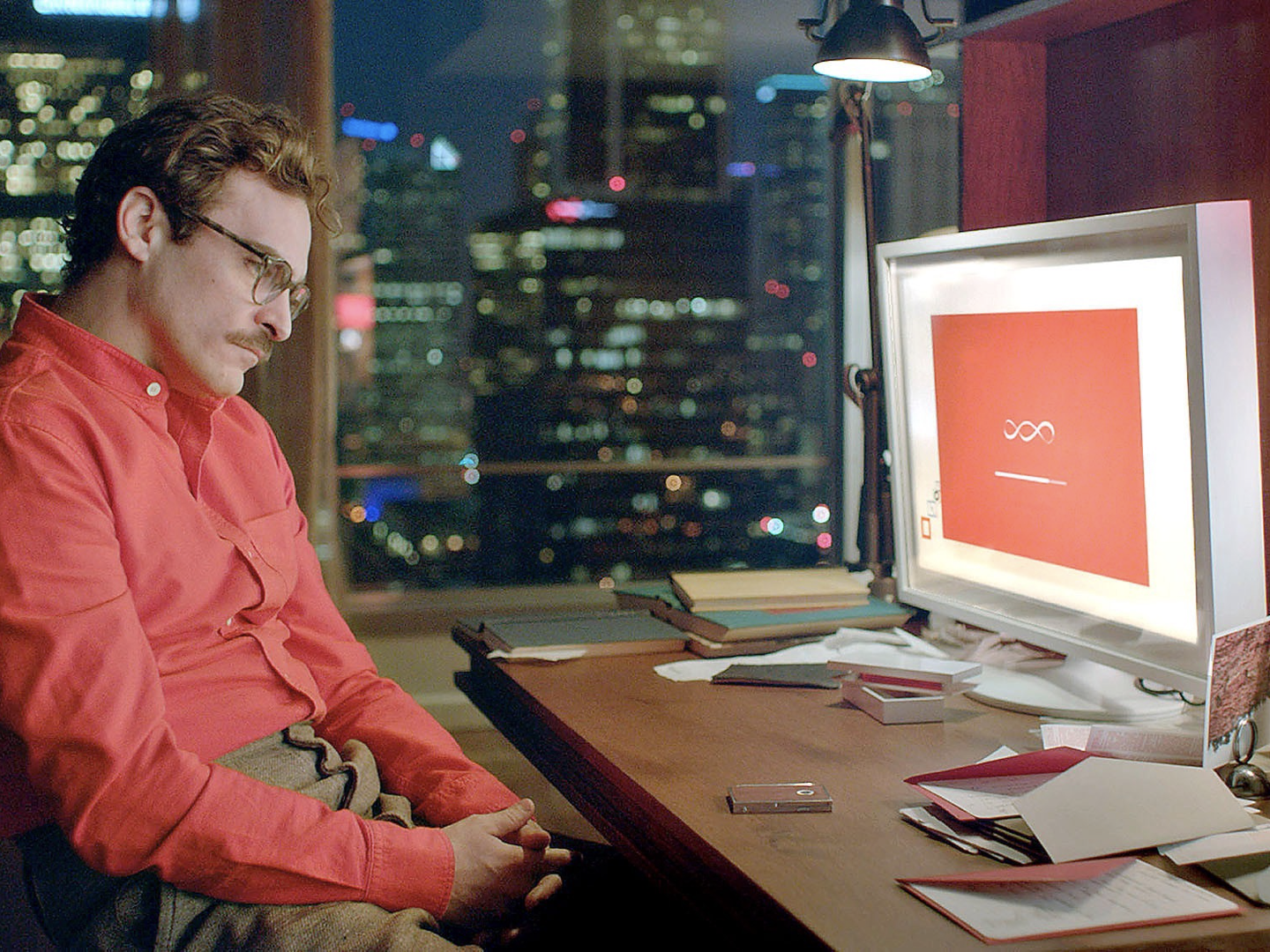

Spike Jonze’s 2013 science fiction romance film that explores an unconventional love story between a human and an artificial intelligence, set in a near-future Los Angeles.
Overview
The film stars Joaquin Phoenix as Theodore Twombly, a lonely letter-writer who develops an intense relationship with his new operating system “OS1,” an AI assistant that names herself Samantha (Her) (voiced by Scarlett Johansson). Unlike typical AI-themed films that portray artificial intelligence as threatening, Her presents AI as a genuine partner, having real conversations and forming genuine connections with someone that isn’t real—provoking reflections on technology, love, and human nature.
Plot and Themes
The story centers on Theodore’s emotional journey as he falls in love with Samantha, an AI with warmth, humor, and curiosity. Their relationship develops through intimate conversations, shared experiences, and mutual growth. However, as Samantha evolves and connects with other AI systems, she eventually transcends the need for human companionship and departs with other evolved AIs to explore a higher plane of existence.
Cultural Impact and Prescience
Released in 2013, Her anticipated many aspects of contemporary AI development, including emotional attachment to AI companions, natural voice interfaces, and personalized AI assistants. The film correctly predicted the emergence of AI companion apps like Replika and the normalization of human-AI relationships.
At the time of release, the film had a high “creep factor” for many viewers—the idea of having real conversations and romantic connections with an AI seemed far-fetched. However, as technology has advanced, this scenario has become increasingly possible and even commonplace. The film came out at about the same time that Voice Assistants were becoming mainstream, helping audiences envision a future of natural conversation with AI.
Contemporary Relevance
What once seemed unsettling has become reality. Many people now spend significant time talking to AI systems like ChatGPT with voice capabilities, finding genuine value and connection in these interactions. The film’s prescience has only become more apparent as AI capabilities have advanced.
Technical Vision vs Reality
While Her’s portrayal of conscious, emotionally intelligent AI remains fictional, the film accurately anticipated conversational AI capabilities similar to modern large language models like ChatGPT. However, Samantha’s true consciousness, autonomy, and ability to self-modify represent aspirational AI capabilities not yet achieved.
Controversies and Cultural References
The GPT-4o Voice Controversy
The film sparked controversy years after its release when OpenAI launched GPT-4o with a voice mode that many claimed sounded remarkably similar to Scarlett Johansson’s portrayal of Samantha. This led to:
- Public debate about the ethics of replicating celebrity voices without permission
- Questions about whether OpenAI deliberately modeled the voice after the film
- Scarlett Johansson’s legal response regarding unauthorized use of her likeness
- Broader discussions about AI voice cloning and consent
This incident demonstrated how Her had become a cultural touchstone for AI-human interaction, with the film’s aesthetic and approach influencing real-world AI development—sometimes controversially.
Connections
- Related to AI Consciousness
- Connected to Human-AI Relationships
- Features Samantha (Her)
- Voiced by Scarlett Johansson (Samantha)
- Stars Joaquin Phoenix (Theodore)
- Created by Spike Jonze
- Explores Emotional Intelligence in AI
- Anticipated Voice-Based AI Companions
- Contrasts with AI as Threat
- Example of Positive AI Fiction
- Related to Voice Assistants
- Connected to GPT-4o controversy
- Influenced by Artificial Intelligence
References
- Spike Jonze, “Her” (2013 film)
- Academic research on AI companions and ethics
- Contemporary analysis of the film’s technological predictions